
A $5,000 acre of land is a liability if it requires $50,000 in utility extensions to become usable. In the 2026 market, the primary pitfalls of buying cheap land are often hidden beneath the surface or buried in local zoning codes. You want to secure your future without the stress of a money pit. It’s a practical goal, but it requires a disciplined approach to due diligence.
We know the fear of buying land that’s legally or physically unbuildable. You need a reliable way to filter out the noise and find properties that offer real value. This guide provides a clear roadmap to avoid common traps like unexpected Phase I ESA costs or restrictive new environmental regulations. You’ll gain the confidence to walk away from risky parcels and the knowledge to spot genuine opportunities. Follow this checklist to ensure your next land purchase is a swift, successful investment.
Key Takeaways
- Recognize how high remediation costs can instantly erase the savings of a low asking price.
- Avoid the primary pitfalls of buying cheap land by investigating zoning laws and legal easements before you commit.
- Budget for the hidden expenses of infrastructure, from power extensions to complex septic system installations.
- Execute a thorough due diligence process to confirm property boundaries and total buildability.
- Leverage a dedicated land marketplace to compare multiple listings and find legitimate bargains nationwide.
Why Cheap Land Isn’t Always a Bargain
A low sticker price is often a smoke screen for expensive problems. Real estate investors frequently fall into the “cheap land trap.” This occurs when a low purchase price is completely offset by high remediation costs. If you buy a parcel for $2,000 but must spend $15,000 to remove hazardous debris or level the terrain, you haven’t found a bargain. You’ve purchased a liability. In the 2026 market, the “buy anything” era is over. Successful investors now focus on intrinsic value rather than just the lowest price point.
Market value and asking price are not the same thing. An asking price is merely a seller’s hope. If a piece of land has been listed for years without a sale, there’s a fundamental flaw. It might be a physical issue like a high water table or a legal hurdle like a lack of recorded access. You must identify the specific pitfalls of buying cheap land before you make an offer. If you can’t explain why the land is discounted, you haven’t done enough research.
Many people believe land is a passive investment. This is a myth. Even undeveloped lots require active management. You’ll deal with annual property taxes, liability insurance, and local weed abatement ordinances. If you buy “cheap” land in a high-tax jurisdiction, your carrying costs could outpace your appreciation. Land is only an asset if the numbers work after all expenses are paid. Don’t let a low entry cost blind you to the ongoing financial commitment.
The Allure of Low-Cost Acreage
Low entry barriers make cheap acreage attractive to first-time investors. It offers a way to build equity without the massive down payments required for residential homes. If a property has a fixable pitfall, the potential for high ROI is significant. A lot might be cheap simply because it lacks a driveway or has overgrown vegetation. Solving these minor issues creates instant equity. To find these opportunities, start with our cheap land for sale guide. Before committing, ensure you understand the legal definition of what is a land lot to verify the parcel’s boundaries and legal status.
Why Sellers Undervalue Their Land
Sellers often have urgent reasons for a low price. Some are distressed sales where the owner needs immediate liquidity to avoid tax foreclosure. Others are heirs who inherited land and have no interest in managing it. They often lack knowledge of local market trends and price the property to move quickly. However, some sellers are strategic. They may be aware of hidden physical or legal constraints that make the land difficult to develop. They price it low to attract buyers who skip the due diligence process. Your job is to distinguish between a motivated seller and a seller offloading a problem. Recognizing these pitfalls of buying cheap land is the difference between a gold mine and a money pit.
Zoning and Legal Traps That Kill Property Value
Zoning is the ultimate authority over your property. If the county designates a lot as agricultural, you cannot simply build a retail store or a high-density apartment complex. Many investors discover the pitfalls of buying cheap land only after they realize their intended use is illegal. Rezoning is a slow, expensive gamble that rarely pays off for small-scale buyers. Always verify the current designation at the county planning office before you sign a contract. Don’t take a seller’s word for what “should” be allowed.
Ownership isn’t always absolute. You might own the surface but not what lies beneath it. In many states, mineral, water, and timber rights are severed from the land. A previous owner may have sold the oil and gas rights decades ago. If so, a drilling company could legally access your property to extract resources. Similarly, if water rights aren’t included, you might be prohibited from drilling a well. Check the deed for “reservations” or “exceptions” to see what you actually own. If the timber rights were sold, a logging company could clear-cut your forest without your permission.
Zoning Restrictions and Land Use
Classifications like Residential, Agricultural, or Industrial are rigid. Residential land often has minimum square footage requirements for any new construction. If you plan to build a tiny home but the zoning requires 1,200 square feet, your investment is effectively dead. Zoning and land use regulations influence everything from building height to how far you must set back structures from the property line. Even “unrestricted” land usually has limitations. Homeowners Associations (HOAs) or Covenants, Conditions, and Restrictions (CC&Rs) often override local laws. These private rules might ban camping, RVs, or livestock on land you thought was free of regulations.
Title Issues and Financial Liens
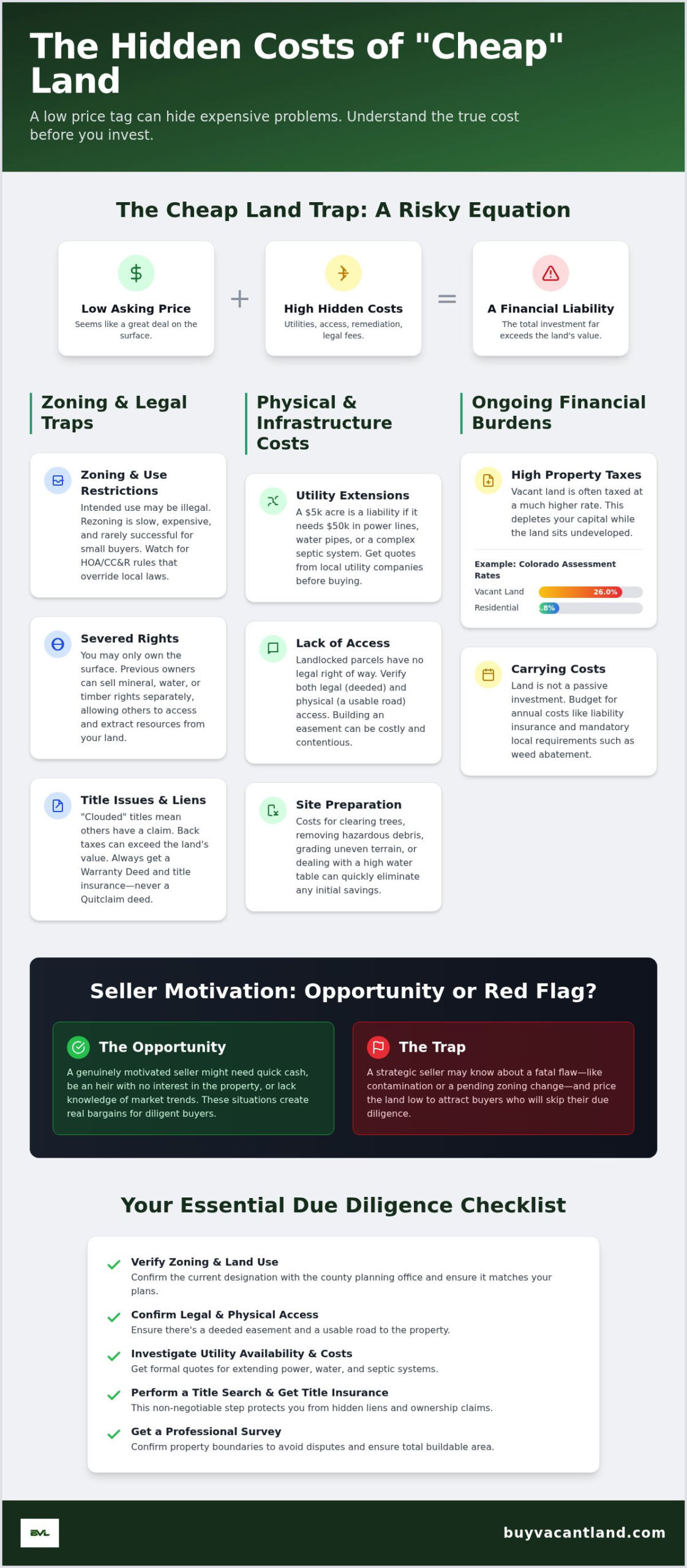
Cheap land often comes with “clouded” titles. This means someone else has a legal claim to the property. Never accept a “Quitclaim” deed for a land investment. A Quitclaim deed only transfers whatever interest the seller might have, with no guarantee that they actually own the parcel. You need a Warranty Deed to ensure a clear transfer of ownership. Financial liens are another major risk. Back taxes can accumulate quickly and often exceed the land’s current market value. In some areas, vacant land is taxed at a much higher rate than residential property. For example, in parts of Colorado, the assessment rate for vacant land is 26%, compared to just 6.8% for residential properties. If an owner hasn’t paid taxes for years, you could inherit a massive bill.
Title insurance is non-negotiable for every transaction. It protects you from hidden liens, heirs claiming ownership, or recording errors made decades ago. It’s a one-time fee that provides permanent peace of mind. Skipping this step is one of the most dangerous pitfalls of buying cheap land. To find properties with more transparent histories, you can browse listings on BuyVacantLand.com and speak with sellers about the property’s legal status before making an offer.
The Hidden Costs of Utilities and Access
Buying raw land is often just the first payment. If the parcel lacks infrastructure, the total cost of ownership will skyrocket. You’ll find that one of the most common pitfalls of buying cheap land is underestimating the price of basic utilities. Nationally, the average total cost to get utilities on vacant land ranges from $9,000 to $34,500. This includes electricity, water, and septic systems. If the property is miles from the nearest service line, those numbers can double or triple quickly.
Electricity alone can drain your budget. Running power from a road to a build site typically costs $5 to $25 per linear foot. On a large parcel, an average total cost of $2,500 to $12,500 is common. If you’re looking at truly off grid land, alternative energy systems like solar or wind are necessary. These systems require a high upfront investment but eliminate monthly utility bills for the long term.
Water access is equally critical. Drilling a residential water well costs between $5,000 and $15,000. You’ll pay by the foot, usually $25 to $65, regardless of whether you hit water or not. If the water quality is poor or the flow rate is too low, the land becomes nearly impossible to develop. Connecting to a city water supply is cheaper, typically $1,000 to $6,000, but only if the pipes already reach your property line.
The Utility Connection Nightmare
A failed percolation (perc) test is a deal-breaker. This test measures soil absorption and is required for septic systems. A perc test costs between $750 and $1,900. If the soil fails, you’ll need a complex aerobic system costing $10,000 to $20,000 or more. Always make your contract contingent on a successful perc test. Without septic or a public sewer connection ($1,500 to $10,000), you cannot legally build a residence.
Access Rights and Easements
Physical access does not equal legal access. A landlocked parcel has no direct legal route to a public road. Never rely on a “handshake” agreement with a neighbor to cross their property. You need deeded access recorded at the county level. Use a due diligence checklist for land buyers to verify access rights before you close the deal.
Shared roads also bring maintenance responsibilities. If you’re at the end of a private road, you might be responsible for grading and snow removal. Check for existing utility easements too. These allow companies to run lines through your property. A poorly placed easement can bisect your building site, making the land useless for your plans. These are the hidden pitfalls of buying cheap land that turn a bargain into a financial burden.
Due Diligence: Your Shield Against Bad Land Deals
Professional due diligence is the only way to verify a bargain. Without it, you are gambling. One of the primary pitfalls of buying cheap land is assuming the seller has done the homework for you. They haven’t. You must verify every claim regarding boundaries, soil quality, and legal status. This process transforms a risky purchase into a calculated investment. It gives you the power to walk away before you lose money.
Hire a local surveyor immediately. A standard residential boundary survey costs between $500 and $1,200 on average. Larger or more complex parcels can cost significantly more. Don’t rely on old fences or GIS maps. Digital maps are often inaccurate by several feet. A physical survey marks the exact corners of your property. This prevents future disputes with neighbors. It ensures you aren’t building on someone else’s land. Mark your boundaries clearly before you start any construction.
Step-by-Step Due Diligence Workflow
Your investigation needs a strict order of operations. Conduct a preliminary desktop review using local GIS maps first. This helps you identify obvious issues like lack of road access or massive wetlands. If the land passes this initial screen, order a professional title search. This reveals hidden liens or clouded ownership. Finally, perform physical inspections. This includes perc tests and soil samples to confirm the land can support a foundation. For a deeper dive into this process, consult our beginner’s guide on how to buy land. Following a set sequence saves time and money on bad deals.
Environmental and Physical Testing
Environmental constraints can halt development instantly. A Phase I Environmental Site Assessment (ESA) is essential for many deals. In 2026, these typically cost between $2,200 and $4,000. This test checks for contamination or hazardous materials from previous uses. You must also account for the 2025 “Waters of the United States” (WOTUS) rule. This rule clarifies federal jurisdiction over water features on your land. If your parcel contains protected wetlands, your building plans may be rejected. Check for endangered species or archaeological constraints at the county level. Soil stability and slope analysis are also vital. Steep terrain or unstable soil can double your construction costs. Verify every detail with the county planning department before you close. To find land that has already been vetted by motivated sellers, visit BuyVacantLand.com and start your search today.
Finding Secure Deals on the BuyVacantLand Marketplace
Navigating the open market for raw acreage is exhausting and risky. You need a centralized hub to filter out the noise and find legitimate opportunities. BuyVacantLand.com provides a specialized marketplace to compare national listings side-by-side. This platform helps you avoid the common pitfalls of buying cheap land by putting multiple options in front of you instantly. You can quickly spot outliers where the price seems too good to be true and investigate them before committing capital.
Traditional bank loans for raw land are difficult to secure. Interest rates often range from 8.5% to over 10%, and down payments can reach 50% of the purchase price. This is why many investors explore owner financed land for a more flexible entry. This option allows you to bypass strict bank hurdles and secure a property with terms that fit your budget. You can filter your search by specific land types, including residential lots, hunting land, or off-grid parcels, to ensure the property matches your long-term goals.
Leveraging Marketplace Data
Data is your best defense against a bad investment. Use the marketplace to compare the price-per-acre across similar regions. If a five-acre lot in a specific county costs half of what neighboring parcels do, you’ve identified a potential red flag. This transparency allows you to identify suspicious listings through historical data and current market trends. Direct communication with land owners and sellers is a core feature of the platform. Use this access to ask critical due diligence questions about access, utilities, and zoning before you spend money on physical inspections.
Closing the Deal with Confidence
Closing a land deal shouldn’t be a source of anxiety. It should be a streamlined process that leads to peace of mind. Use professional closing services and title companies to handle the legal transfer of the deed. This ensures the transaction is recorded correctly and all previous liens are cleared. Your purchase agreement must include clear contingencies for the perc tests, surveys, and environmental assessments discussed in previous sections. If the land doesn’t meet your requirements during the inspection period, you can walk away without losing your investment. This structured approach helps you navigate the pitfalls of buying cheap land and transition from a cautious buyer to a successful land owner with total confidence.
Secure Your Land Investment Strategy
Successful land ownership starts with a clear head and a strict checklist. You now know how to identify the pitfalls of buying cheap land by verifying zoning, calculating utility extensions, and performing rigorous due diligence. These steps are the only way to transform a low-cost parcel into a high-value asset. Don’t let a low sticker price distract you from the technical requirements of buildability.
You need a platform that simplifies the search and cuts through the noise. BuyVacantLand.com is a specialized land-only marketplace that connects you directly with sellers. There are no hidden service fees for buyers. This direct connection allows you to ask critical questions before you spend money on inspections. It’s the most efficient way to compare national listings and find the legitimate bargains that others miss.
Take control of your investment future today. Browse Verified Vacant Land Listings Now to start your search. With the right data and a disciplined approach, you can build lasting wealth through raw land. Your next great opportunity is just a click away.
Frequently Asked Questions
Is cheap land always a scam?
No, but it’s often a liability in disguise. Low prices usually reflect a specific physical or legal limitation that the seller wants to offload. Legitimate bargains exist through distressed sales or tax foreclosures where the owner needs immediate liquidity. You must identify the exact reason for the discount before making an offer. If you can’t find a flaw, you haven’t looked hard enough.
What does “unrestricted land” really mean?
It means the property is free from private deed restrictions or Homeowners Association (HOA) rules. However, local zoning laws and state environmental regulations still apply. You cannot ignore building codes or waste management requirements just because a lot is labeled “unrestricted.” Always verify the county’s specific land-use designations to confirm your plans are legal.
Can I build on land without road access?
Legally, you need deeded access to obtain a building permit in most jurisdictions. Physically building on a landlocked parcel is nearly impossible because you can’t get equipment or materials to the site. Landlocked properties are one of the primary pitfalls of buying cheap land. Never close a deal without a recorded easement that grants you a legal route to a public road.
How do I check for liens on a cheap parcel?
Order a professional title search through a reputable title company. This search reveals back taxes, existing mortgages, or legal judgments that could become your responsibility after the sale. A title search is the only reliable way to ensure you’re buying a clean asset. Don’t rely on a seller’s verbal promise that the title is clear.
Why is a land survey mandatory for low-cost land?
A survey confirms the exact boundaries and total acreage of the property. Cheap land often has poorly defined borders or encroaching structures from neighboring lots. It prevents future legal disputes and ensures you aren’t building on someone else’s property. Digital GIS maps are frequently inaccurate by several feet and shouldn’t be used for construction planning.
What is a percolation (perc) test and why does it matter?
A perc test measures how quickly the soil absorbs water, which determines if the land can support a septic system. If the soil fails this test, you might be prohibited from building any residence on the property. Failing soil is a common reason for extremely low land prices. Always make your purchase contract contingent on a successful perc test result.
Are there hidden property taxes on vacant land?
Yes, especially if the land is reassessed at a higher value after the sale. Some states tax vacant land at a much higher rate than residential property to encourage development. For example, some jurisdictions use assessment rates as high as 26% for raw land. Check the current tax status and the potential for a “rollback tax” with the local county assessor.
Can I get a bank loan for cheap vacant land?
Traditional bank loans for raw land are difficult to secure because lenders view it as a high-risk investment. You’ll likely face interest rates between 8.5% and 10% and require a down payment of up to 50%. These strict terms are major pitfalls of buying cheap land for cash-strapped investors. Many buyers use owner financing to bypass these hurdles and secure land with more flexible terms.




Join The Discussion