
What if your “perfect” five-acre lot is actually just a very expensive pile of dirt that you can never build on? It is the nightmare scenario for every land buyer. You find the right location and the right price, but the soil refuses to drain. Without a successful test, you cannot install a septic system, and your dream home remains a blueprint. You need to know exactly what is a percolation test for land before you sign a contract or break ground.
It is natural to feel overwhelmed by technical soil terminology and shifting health department regulations. You want to protect your investment and move forward with confidence. This 2026 guide simplifies the entire process. You will learn how a perc test determines if your land is buildable, how it impacts your property value, and the specific steps to order one today. We cover everything from the $15,000 septic loan programs available in Florida to the critical wet weather testing deadlines that recently closed in Maryland on April 22, 2026. Use this information to turn a risky purchase into a secure asset.
Key Takeaways
- Define what is a percolation test for land to confirm your soil can effectively filter wastewater.
- Master the professional testing sequence from digging holes to pre-soaking the site for accurate results.
- Prepare for alternative septic solutions if your land fails to meet standard drainage requirements.
- Increase your property’s market value by securing “perc-approved” status before listing your lot.
- Time your test correctly to avoid frozen soil and strict seasonal deadlines set by local health departments.
What is a Perc Test and Why is it Essential for Land?
A percolation test is a non-negotiable requirement for anyone looking to build on undeveloped property. It measures the specific rate at which soil absorbs liquid. This data is critical for any parcel where municipal sewer lines are unavailable. You cannot simply dump wastewater into the ground; it must be treated and filtered naturally. Understanding what is a percolation test for land is the first step in ensuring your property is actually a viable homesite rather than just a decorative lot.
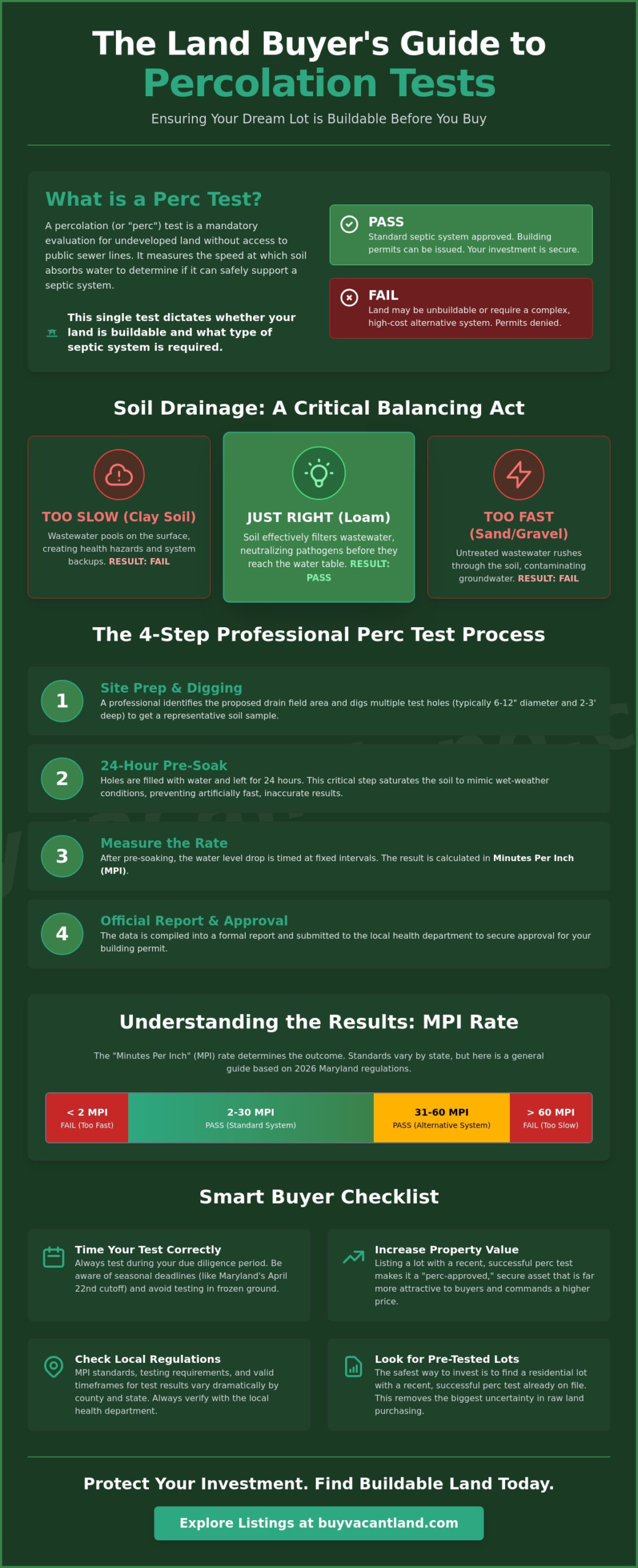
The test results determine if your land can effectively filter wastewater before it reaches the local water table. If the soil drains too slowly, waste pools on the surface. If it drains too quickly, contaminants enter the groundwater untreated. This test isn’t just a formality. It dictates the engineering of your entire septic system. A passing result means you can move forward with standard construction. A failing result could mean your land is unbuildable or requires a specialized, high-cost alternative system. Local health departments use these results to issue or deny your building permits.
The Link Between Soil and Septic Systems
Septic systems rely on a “leach field” to process waste naturally. Think of the soil as a living biological filter. Dense clay soil acts like a plug. It stops water from moving, leading to backups and surface contamination. Conversely, extremely sandy or rocky soil might let liquid pass through too fast. In these cases, the soil doesn’t have time to neutralize pathogens. You need a specific drainage zone to protect both your home and the environment. If the soil fails to provide this balance, the land cannot support a standard septic drain field.
When You Should Request a Perc Test
Timing is everything in real estate. You must order a test during your due diligence period before you finalize any land purchase. This protects your capital from being tied up in “unbuildable” dirt. Local health departments also require a current test when you apply for a new residential building permit. Even if you already own the land, you might need a new test if you are renovating. Adding bedrooms increases your septic capacity needs. This often triggers a requirement for a fresh test to prove the soil can handle the additional load. Always confirm the current health department requirements in your specific county before starting any project. Knowing what is a percolation test for land and when to order it saves you from expensive legal and construction hurdles later.
How a Percolation Test is Conducted: The Step-by-Step Process
Understanding what is a percolation test for land requires looking at the physical steps taken on-site. It is a precise, multi-day operation that leaves no room for guesswork. Professional testers don’t just dig a hole and pour water in. They follow a strict protocol designed to simulate the worst-case scenario for your future septic system. This ensures the ground can handle wastewater even during the wettest months of the year.
The process follows a logical sequence to provide reliable data for health department officials. Skipping a step or rushing the timeline leads to inaccurate results. This could result in a denied building permit or a system failure after you move in. Efficiency and accuracy are the primary goals of every certified tester.
Preparation and Pre-Soaking
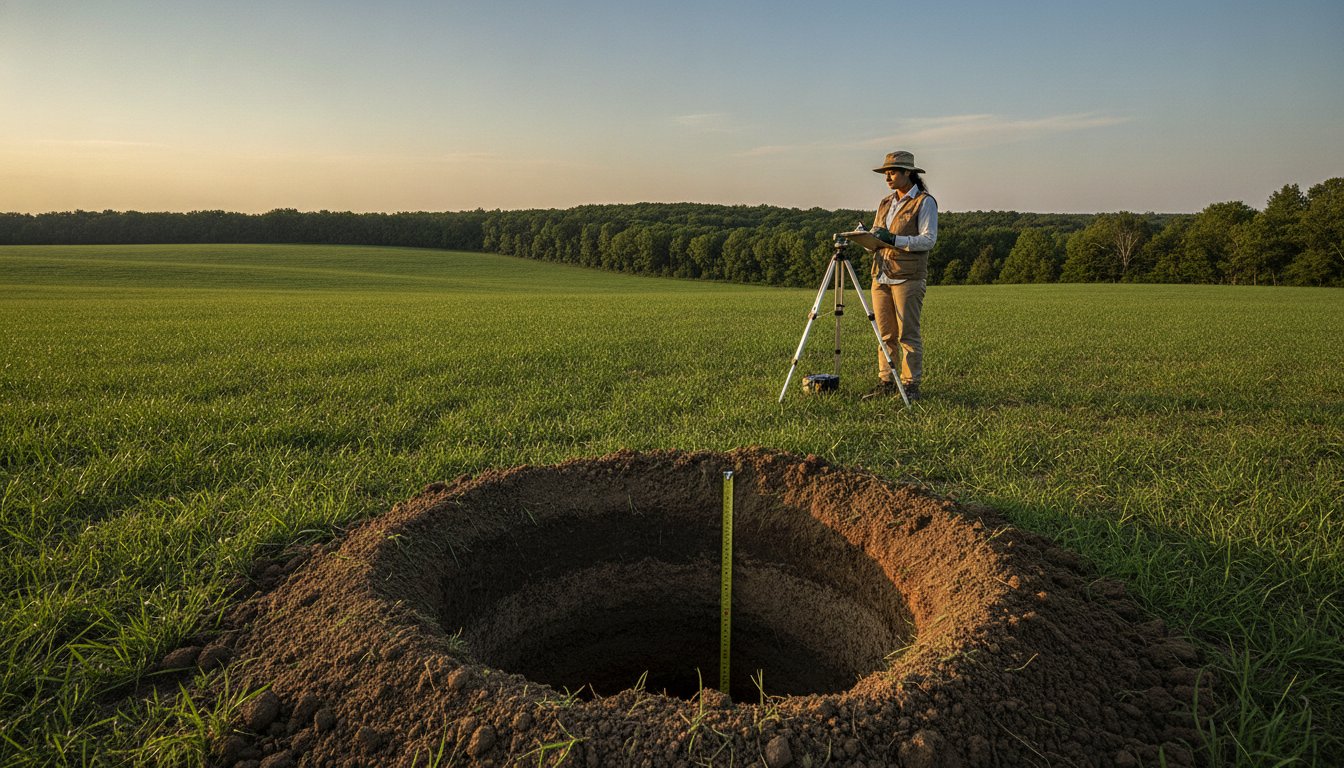
The tester begins by identifying the exact location of your proposed drain field. They dig several test holes to get a representative sample of the soil. In Pennsylvania, regulations as of February 2026 require a minimum of six test holes for any absorption area up to 1,000 square feet. These holes are typically 6 to 12 inches in diameter and reach depths of 2 to 3 feet. Once the holes are cleared of loose debris, the pre-soaking phase begins.
Pre-soaking is a critical 24-hour process. Testers fill the holes with water a full day before the official measurement. This saturates the surrounding soil completely. It prevents “false positives” where dry, thirsty soil absorbs water at an artificially high rate. By the time the actual test starts, the ground is in a state of total saturation, mimicking real-world conditions during heavy rain or snowmelt.
Measuring the Percolation Rate
After the pre-soak, the tester adds water to a specific level and begins the clock. They monitor the water level drop at fixed intervals, often every 30 minutes. This measurement determines the drop rate in “minutes per inch” (MPI). Every state has its own standards for what constitutes a pass. For example, Maryland standards for 2026 state that conventional tile field systems cannot exceed a rate of 30 MPI. If the water drops faster than 2 minutes per inch, the soil is too porous and also fails because it won’t filter waste effectively. Sand mound tests in the same region allow for a slower rate of up to 60 MPI.
The final data is compiled into a formal report. This document is your proof of land suitability. If you are currently scouting for residential lots, finding a parcel with a recent, successful perc test on file is the most reliable way to protect your investment. The tester submits these findings to your local health department for official approval, clearing the path for your building permit.
The Cost and Timing of a Land Perc Test
Budgeting for a site evaluation is a critical step in your land acquisition strategy. You shouldn’t view this as a hurdle. It is an insurance policy for your capital. A standard test nationwide typically costs between $750 and $1,850. Most property owners find themselves paying between $1,000 and $1,300 for a professional assessment. In Florida, the average cost sits around $1,300, though prices can reach $1,900 depending on the specific county and soil conditions. While these figures represent the professional service, you must also account for local health department application fees, which vary by jurisdiction.
Spending a few thousand dollars now prevents you from spending hundreds of thousands on a lot you can’t use. Understanding what is a percolation test for land includes recognizing that the price of the test is negligible compared to the loss of buying “unbuildable” dirt. Professional testers provide the data you need to make a fast, informed decision. This clarity is what allows you to move from a prospect to a closed deal with total peace of mind.
Factors Influencing the Price
The complexity of your soil determines the final invoice. A basic test using hand-dug holes is the most affordable option, usually ranging from $300 to $1,000. However, many modern building codes require deeper insights. If your site needs deep holes to check for seasonal high water tables, you will likely need an excavator. Excavator-assisted tests range from $750 to over $2,000. If your land has difficult terrain or requires a full engineering report, costs can climb to $3,000. Testing multiple sites on a single large parcel will also increase the total service fee because of the additional labor and equipment time required.
Scheduling and Seasonal Considerations
Timing is just as important as the cost. You cannot always test on your own schedule. Many regions have “wet weather” windows to capture the soil’s performance during its most saturated state. For example, in Maryland, the 2026 testing season for wet weather soils closed on April 22. These windows are adjusted annually based on groundwater levels. If you miss the window, you might have to wait until the following year to get an approved permit.
Plan for a lead time of at least two to four weeks to secure a spot on a licensed tester’s calendar. Frozen ground or extreme drought can also delay your results, as these conditions produce inaccurate data. Always check your local health department’s current calendar before you begin your due diligence. Knowing what is a percolation test for land means knowing when the soil is ready to give you an honest answer.
What Happens if Your Land Fails a Perc Test?
A failed report is a significant hurdle, but it isn’t always a dealbreaker. It simply means your soil cannot support a standard, gravity-fed septic system. This happens when the absorption rate is too slow or the water table is too high. You must realize that a failure will increase your construction budget. However, modern engineering offers ways to build on land that was once considered unusable. Understanding what is a percolation test for land results allows you to pivot your strategy rather than abandoning your investment.
Do not panic if the initial results are poor. Your first step is to consult a civil engineer or a septic designer. They can review the data and propose a custom solution. These “engineered” systems are more complex and require higher maintenance, but they provide the path to a building permit. You are essentially replacing the natural soil’s filtering job with technology and imported materials. This ensures your home remains safe and your groundwater remains clean.
Common Reasons for Failure
High clay content is the most frequent culprit. Clay particles are microscopic and pack together tightly, creating an impermeable barrier. Water simply sits in the test hole without draining. Shallow bedrock is another common issue. If solid rock is within three feet of the surface, there isn’t enough soil depth to treat the waste effectively. Additionally, high seasonal water tables can cause a fail. If the groundwater rises too high during the spring, it floods the leach field. This prevents the system from functioning and risks contaminating the local water supply, which is a major concern in areas like Suffolk County, New York, where high nitrate levels are already a problem.
Alternative Septic Solutions
If a traditional system is out of the question, you have three primary alternatives. Mound systems are the most common. You build an artificial drainage area above the natural ground level using specific layers of sand and gravel. This provides the filtration distance the native soil lacks. Aerobic Treatment Units (ATUs) are another growing trend. These units use oxygen to break down waste faster than standard tanks. They are more efficient and can often be installed on challenging sites where space or soil quality is limited. Some of these modern units even integrate IoT sensors for real-time performance monitoring.
Drip irrigation septic systems offer a third path. These distribute treated wastewater over a large area at a very shallow depth through specialized tubes. This is perfect for land with shallow bedrock or high water tables. While these systems cost more, they protect your property value and allow for development on difficult lots. If you want to skip the stress of alternative engineering, search for undeveloped vacant land that has already passed its initial site evaluation. This ensures a faster path to construction without the extra fees.
Buying and Selling Land with Perc Test Data
A perc test is the ultimate appraisal for undeveloped property. It transforms a risky asset into a shovel-ready investment. Knowing what is a percolation test for land gives you a massive advantage in the 2026 real estate market. For sellers, it justifies a higher asking price and attracts serious developers. For buyers, it eliminates the fear of purchasing a useless parcel. Marketplaces like BuyVacantLand.com streamline this by allowing you to filter for properties with documented utilities and site evaluations.
Investors often look for cheap land for sale, but the lowest price doesn’t always mean the best deal. A lot without a perc test is a gamble that could cost you thousands in alternative engineering later. Always prioritize listings that provide transparency. This data is the foundation of a swift and secure transaction. It moves the deal forward without the traditional procedural hurdles that stall most land sales.
Maximizing Value as a Seller
If you want to sell your land fast, remove the friction. Provide the perc test report as a downloadable attachment in your listing. Serious developers won’t wait for you to schedule a test, especially if you missed a seasonal window like the Maryland wet weather deadline on April 22, 2026. Highlight “Septic Approved” or “Perc Tested” in your headline. This immediately attracts buyers who are ready to break ground. You should also understand how do you buy land from a professional perspective. This insight helps you anticipate buyer objections. You can provide the documentation they need before they even ask. A small upfront investment in a test can yield a significantly higher return on your final sale price.
Protecting Yourself as a Buyer
Never take a verbal “it percs” as a guarantee. Demand the official report from the local health department. Verify the exact location of the test holes on the plat map. If the test was done on the far corner of a 20-acre lot, it might not apply to your desired building site. You must also check the expiration date. Many counties require a re-test if the data is more than five years old. If a test is expired or marginal, use it as a negotiation tool to lower the purchase price.
Keep in mind that financial assistance is available if the results are challenging. Programs like SERCAP offer loans up to $15,000 at a 1% interest rate for septic installations in rural communities in Florida and Delaware. This financial cushion helps if you need to install an alternative system on a lot that didn’t pass for a standard field. Confirming what is a percolation test for land and checking the paperwork is your best defense against a bad investment. Use this data to close your deal with total peace of mind.
Secure Your Land Investment Today
Soil drainage dictates the future of your property. A passing test is the difference between a buildable lot and a costly liability. You now have the knowledge to navigate seasonal deadlines and engineering alternatives with ease. Understanding what is a percolation test for land ensures you never overpay for a parcel that lacks development potential. It protects your capital and simplifies your path to a building permit. Accurate data is the only way to guarantee your land is an asset rather than a burden.
Take the next step in your real estate journey. Our specialized marketplace for raw land offers national coverage across the entire United States. You can reach thousands of targeted land buyers who are actively searching for ready-to-build lots with clear documentation. Start listing your perc-approved land today on our marketplace. It is the fastest, most efficient way to turn your property into a liquid asset. Move forward with confidence and a solid plan. Your successful build starts with the right soil data.
Frequently Asked Questions
How long is a perc test valid for?
Validity periods vary by local jurisdiction. Most counties consider a test valid for two to five years. Some areas allow for “grandfathered” results if the soil conditions haven’t changed. Always check with your local health department to confirm if an old report is still legal for a new permit.
Can I do my own perc test for a building permit?
You cannot perform your own test for an official building permit. Local health departments require a licensed professional engineer or a certified soil scientist to conduct the evaluation. An official from the county often must witness the process to verify the data. This ensures the results are accurate and legally binding.
What is a good perc rate for a septic system?
A good percolation rate typically falls between 5 and 30 minutes per inch (MPI). Maryland standards for 2026 require a rate of 30 MPI or less for conventional systems. If the rate is between 30 and 60 MPI, you might need a sand mound system. Anything slower than 60 MPI usually results in a failure for standard drainage.
Does a failed perc test mean I can’t build a house?
A failure doesn’t stop construction, but it changes the plan. You will likely need an alternative system like an Aerobic Treatment Unit (ATU) or a mound system. These options are more expensive than standard gravity-fed fields. Consult a civil engineer to design a custom solution that meets local health codes.
What is the difference between a perc test and a deep hole test?
A perc test measures how fast water drains; a deep hole test identifies the water table and bedrock depth. You need both for a complete site evaluation. The deep hole ensures you have enough vertical soil to filter waste before it hits groundwater. The perc test confirms the horizontal absorption speed.
Do I need a perc test if I’m buying land with a well?
Yes, a perc test is mandatory even if you have a private well. You must prove the soil can treat wastewater before it reaches the aquifer that feeds your well. Local regulations require specific setback distances between your septic drain field and any water source to prevent contamination.
How much land do I need for a septic drain field?
Plan to reserve at least 1/4 to 1/2 acre for your septic system and a backup replacement area. The exact size depends on your perc rate and the number of bedrooms in your home. Slower-draining soil requires a larger footprint to process the same amount of waste effectively.
Is a perc test required for off-grid land?
You need a test for off-grid land if you plan to install a permanent septic system. Building permits for residential lots depend on proof of safe waste disposal. Even if you are far from municipal lines, you must comply with state health standards to protect the local environment. Understanding what is a percolation test for land is vital for any off-grid developer.




Join The Discussion